Inheritance
Using Members of One Class inside Another Class
We can use members of one class inside another class by using the following ways
1) By Composition (Has-A Relationship) 2) By Inheritance (IS-A Relationship)
1) By Composition (Has-A Relationship)
- By using Class Name or by creating object we can access members of one class inside another class is nothing but composition (Has-A Relationship).
- The main advantage of Has-A Relationship is Code Reusability.
Demo Program-1:
class Engine:
    a=10
    def __init__(self):
        self.b=20
    def m1(self):
        print('Engine Specific Functionality')
class Car:
    def __init__(self):
        self.engine=Engine()
    def m2(self):
        print('Car using Engine Class Functionality')
        print(self.engine.a)
        print(self.engine.b)
        self.engine.m1()
c=Car()
c.m2()
Output:
Demo Program-2:
class Car:
    def __init__(self,name,model,color):
        self.name=name
        self.model=model
        self.color=color
    def getinfo(self):
        print("Car Name:{} , Model:{} and Color:{}".format(self.name,self.model,self.color))

class Employee:
    def __init__(self,ename,eno,car):
        self.ename=ename
        self.eno=eno
        self.car=car
    def empinfo(self):
        print("Employee Name:",self.ename)
        print("Employee Number:",self.eno)
        print("Employee Car Info:")
        self.car.getinfo()
c=Car("Innova","2.5V","Grey")
e=Employee('Durga',10000,c)
e.empinfo()
Output:
Employee Name: Durga
Employee Number: 10000
Employee Car Info:
Car Name: Innova, Model: 2.5V and Color:Grey
In the above program Employee class Has-A Car reference and hence Employee class can access all members of Car class.
Demo Program-3:
class X:
    a=10
    def __init__(self):
        self.b=20
    def m1(self):
            print("m1 method of X class")

class Y:
    c=30
    def __init__(self):
        self.d=40
    def m2(self):
        print("m2 method of Y class")

    def m3(self):
        x1=X()
        print(x1.a)
        print(x1.b)
        x1.m1()
        print(Y.c)
        print(self.d)
        self.m2()
        print("m3 method of Y class")
y1=Y()
y1.m3()
Output:
2) By Inheritance (IS-A Relationship)
What ever variables, methods and constructors available in the parent class by default available to the child classes and we are not required to rewrite. Hence the main advantage of inheritance is Code Reusability and we can extend existing functionality with some more extra functionality.
Syntax: class childclass(parentclass)
class P:
    a=10
    def __init__(self):
        self.b=10
    def m1(self):
        print('Parent instance method')
    @classmethod
    def m2(cls):
        print('Parent class method')
    @staticmethod
    def m3():
        print('Parent static method')

class C(P):
    pass

c=C()
print(c.a)
print(c.b)
c.m1()
c.m2()
c.m3()
Output:
In the above example Parent class contains 10 methods and these methods automatically available to the child class and we are not required to rewrite those methods(Code Reusability)
Hence child class contains 15 methods.
Note: What ever members present in Parent class are by default available to the child
class through inheritance.
class P:
    def m1(self):
        print("Parent class method")
class C(P):
    def m2(self):
        print("Child class method")

c=C();
c.m1()
c.m2()
Output:
What ever methods present in Parent class are automatically available to the child class and hence on the child class reference we can call both parent class methods and child
class methods.
Similarly variables also
class P:
    a=10
    def __init__(self):
        self.b=20
class C(P):
    c=30
    def __init__(self):
        super().__init__()===>Line-1
        self.d=30

c1=C()
print(c1.a,c1.b,c1.c,c1.d)
If we comment Line-1 then variable b is not available to the child class.
Demo program for Inheritance:
class Person:
    def __init__(self,name,age):
        self.name=name
        self.age=age
    def eatndrink(self):
        print('Eat Biryani and Drink Beer')

class Employee(Person):
    def __init__(self,name,age,eno,esal):
        super().__init__(name,age)
        self.eno=eno
        self.esal=esal

    def work(self):
        print("Coding Python is very easy just like drinking Chilled Beer")
    def empinfo(self):
        print("Employee Name:",self.name)
        print("Employee Age:",self.age)
        print("Employee Number:",self.eno)
        print("Employee Salary:",self.esal)

e=Employee('Durga', 48, 100, 10000)
e.eatndrink()
e.work()
e.empinfo()
Output:
Eat Biryani and Drink Beer
Coding Python is very easy just like drinking Chilled Beer
Employee Name: Durga
Employee Age: 48
Employee Number: 100
Employee Salary: 10000
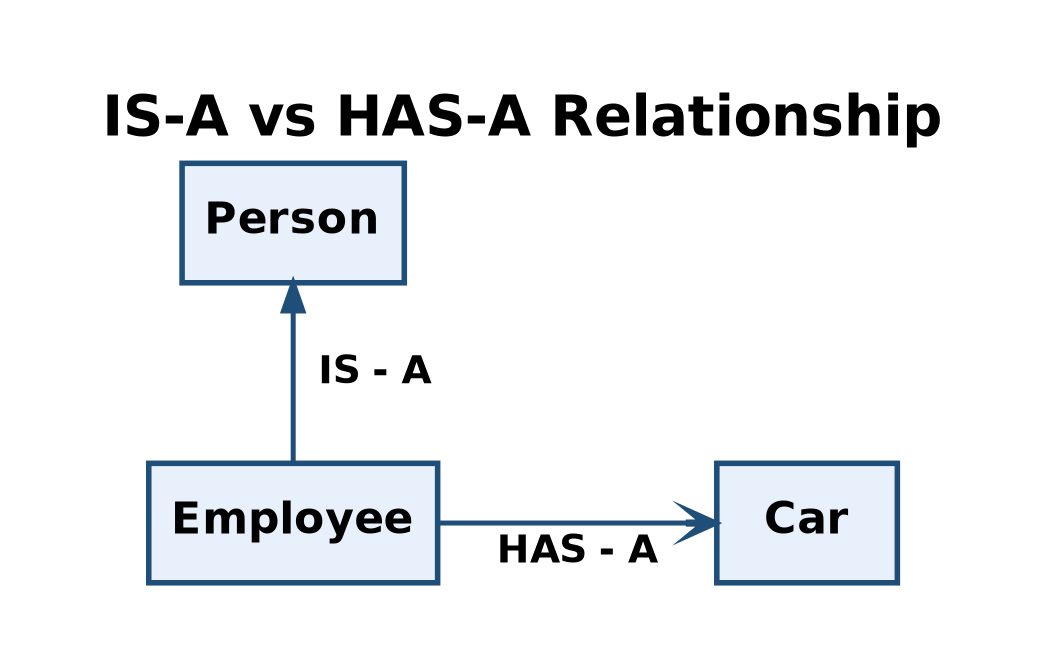
IS-A vs HAS-A Relationship
- If we want to extend existing functionality with some more extra functionality then we should go for IS-A Relationship.
- If we dont want to extend and just we have to use existing functionality then we should go for HAS-A Relationship.
- Eg: Employee class extends Person class Functionality But Employee class just uses Car functionality but not extending
class Car:
    def __init__(self,name,model,color):
        self.name=name
        self.model=model
        self.color=color
    def getinfo(self):
        print("\tCar Name:{} \n\t Model:{} \n\t Color:{}".format(self.name,self.model, self.color))

class Person:
    def __init__(self,name,age):
        self.name=name
        self.age=age
    def eatndrink(self):
        print('Eat Biryani and Drink Beer')

class Employee(Person):
    def __init__(self,name,age,eno,esal,car):
        super().__init__(name,age)
        self.eno=eno
        self.esal=esal
        self.car=car
    def work(self):
        print("Coding Python is very easy just like drinking Chilled Beer")
    def empinfo(self):
        print("Employee Name:",self.name)
        print("Employee Age:",self.age)
        print("Employee Number:",self.eno)
        print("Employee Salary:",self.esal)
        print("Employee Car Info:")
        self.car.getinfo()

c=Car("Innova","2.5V","Grey")
e=Employee('Durga',48,100,10000,c)
e.eatndrink()
e.work()
e.empinfo()
Output:
Eat Biryani and Drink Beer
Coding Python is very easy just like drinking Chilled Beer
Employee Name: Durga
Employee Age: 48
Employee Number: 100
Employee Salary: 10000
Employee Car Info:
    Car Name:Innova
    Model:2.5V
    Color:Grey
In the above example Employee class extends Person class functionality but just uses Car
class functionality.
Composition vs Aggregation
Composition
Without existing container object if there is no chance of existing contained object then the container and contained objects are strongly associated and that strong association is nothing but Composition.
Eg: University contains several Departments and without existing university object there is no chance of existing Department object. Hence University and Department objects are strongly associated and this strong association is nothing but Composition.
 University Object (Container Object)
   ( (o) (o) (o) (o) (o) )  <-- Department Object (Contained Object)
Aggregation
Without existing container object if there is a chance of existing contained object then the container and contained objects are weakly associated and that weak association is nothing but Aggregation.
Eg: Department contains several Professors. Without existing Department still there may be a chance of existing Professor. Hence Department and Professor Objects are weakly associated, which is nothing but Aggregation.
 Department Object          Professor Object
 (Container Object)         (Contained Object)
   (  x ----------------->  ( )
      x ----------------->  ( )
      :                      :
      x ----------------->  ( )  )
Coding Example:
class Student:
    collegeName='DURGASOFT'
    def __init__(self,name):
        self.name=name
print(Student.collegeName)
s=Student('Durga')
print(s.name)
Output:
In the above example without existing Student object there is no chance of existing his name. Hence Student Object and his name are strongly associated which is nothing but Composition.
But without existing Student object there may be a chance of existing collegeName. Hence Student object and collegeName are weakly associated which is nothing but Aggregation.
Conclusion
The relation between object and its instance variables is always Composition where as the relation between object and static variables is Aggregation.
Note: Whenever we are creating child class object then child class constructor will be executed. If the child class does not contain constructor then parent class constructor will be executed, but parent object won't be created.
Output:
class Person:
    def __init__(self,name,age):
        self.name=name
        self.age=age
class Student(Person):
    def __init__(self,name,age,rollno,marks):
        super().__init__(name,age)
        self.rollno=rollno
        self.marks=marks
    def __str__(self):
        return 'Name={}\nAge={}\nRollno={}\nMarks={}'.format(self.name,self.age,self.rollno,self.marks)
s1=Student('durga',48,101,90)
print(s1)
Output:
Note: In the above example when ever we are creating child class object both parent and child class constructors got executed to perform initialization of child object.
Types of Inheritance
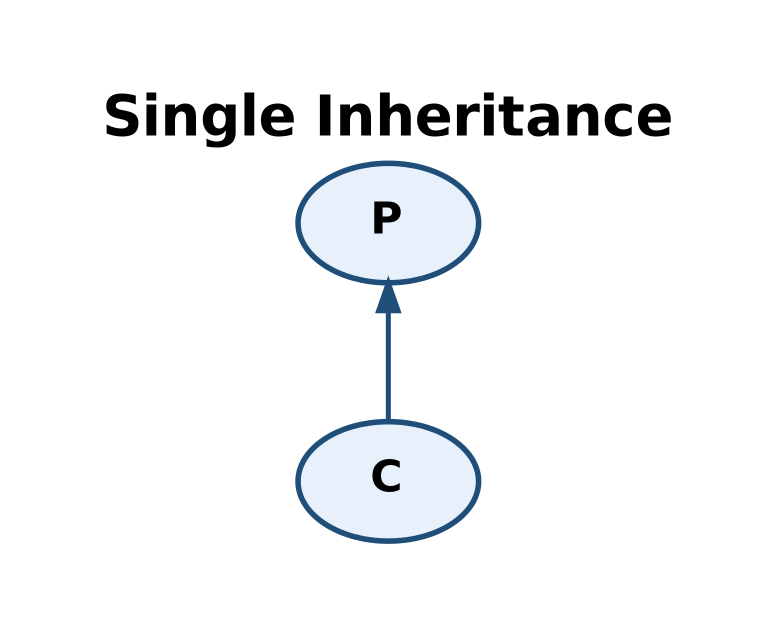
1) Single Inheritance
The concept of inheriting the properties from one class to another class is known as single inheritance.
class P:
    def m1(self):
        print("Parent Method")
class C(P):
    def m2(self):
        print("Child Method")
c=C()
c.m1()
c.m2()
Output:
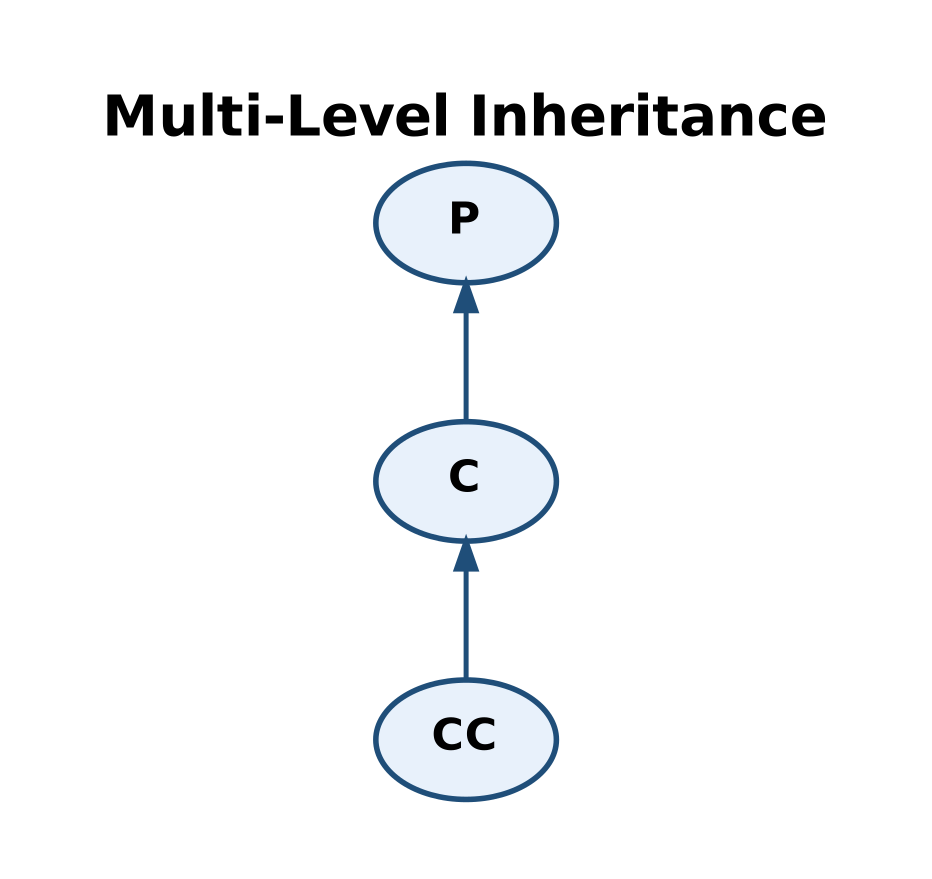
2) Multi Level Inheritance
The concept of inheriting the properties from multiple classes to single class with the concept of one after another is known as multilevel inheritance.
class P:
    def m1(self):
        print("Parent Method")
class C(P):
    def m2(self):
        print("Child Method")
class CC(C):
    def m3(self):
        print("Sub Child Method")
c=CC()
c.m1()
c.m2()
c.m3()
Output:
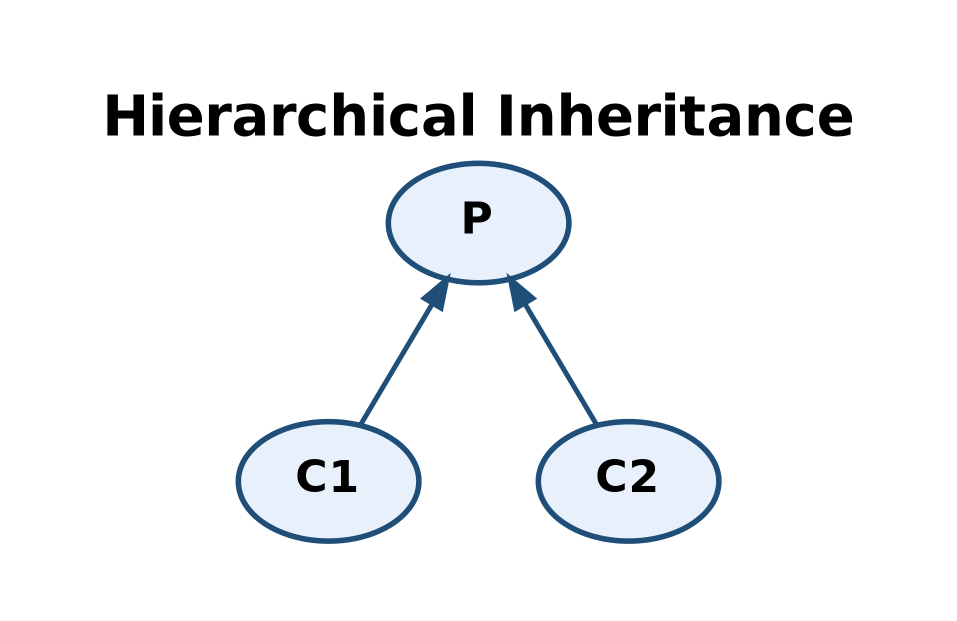
3) Hierarchical Inheritance
The concept of inheriting properties from one class into multiple classes which are present at same level is known as Hierarchical Inheritance
class P:
    def m1(self):
        print("Parent Method")
class C1(P):
    def m2(self):
        print("Child1 Method")
class C2(P):
    def m3(self):
        print("Child2 Method")
c1=C1()
c1.m1()
c1.m2()
c2=C2()
c2.m1()
c2.m3()
Output:
4) Multiple Inheritance
The concept of inheriting the properties from multiple classes into a single class at a time, is known as multiple inheritance.
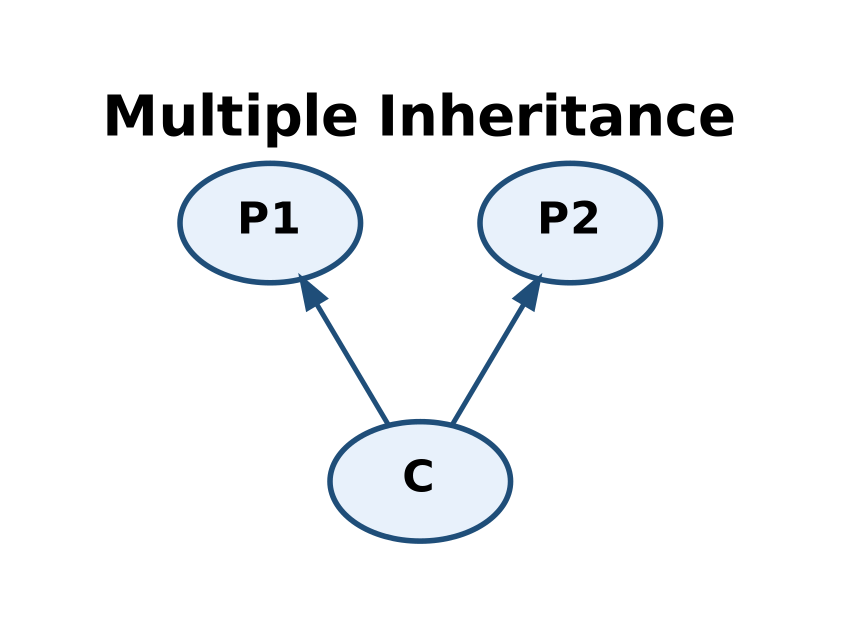
class P1:
    def m1(self):
        print("Parent1 Method")
class P2:
    def m2(self):
        print("Parent2 Method")
class C(P1,P2):
    def m3(self):
        print("Child2 Method")
c=C()
c.m1()
c.m2()
c.m3()
Output:
If the same method is inherited from both parent classes, then Python will always consider the order of Parent classes in the declaration of the child class.
class C(P1, P2): → P1 method will be considered
class C(P2, P1): → P2 method will be considered
class P1:
    def m1(self):
        print("Parent1 Method")
class P2:
    def m1(self):
        print("Parent2 Method")
class C(P1,P2):
    def m2(self):
        print("Child Method")
c=C()
c.m1()
c.m2()
Output:
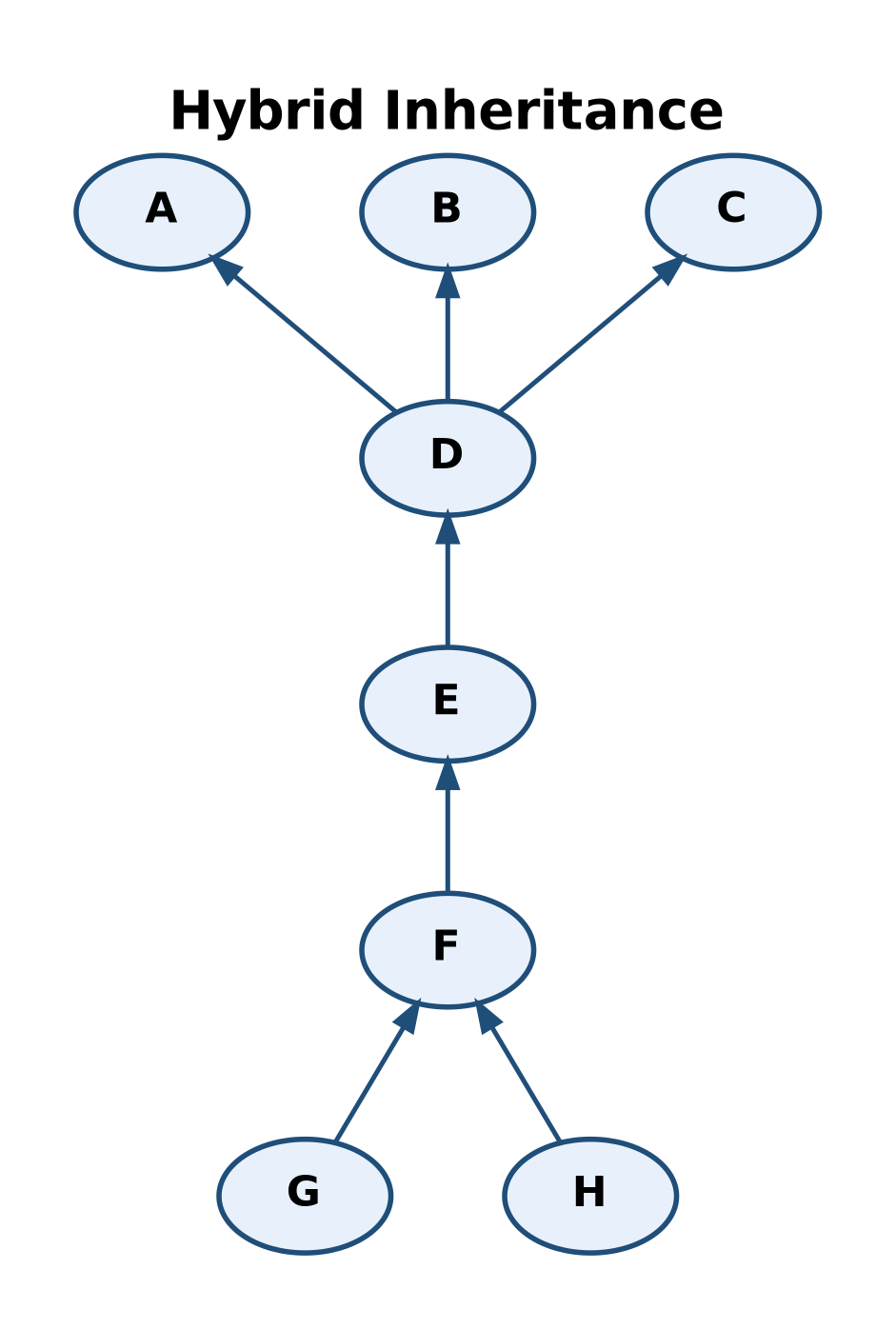
5) Hybrid Inheritance
Combination of Single, Multi level, multiple and Hierarchical inheritance is known as Hybrid Inheritance.
6) Cyclic Inheritance
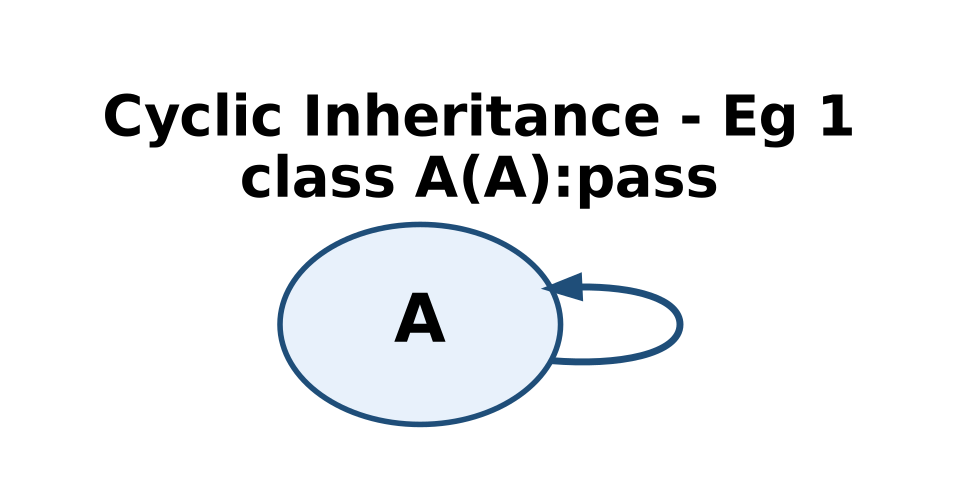
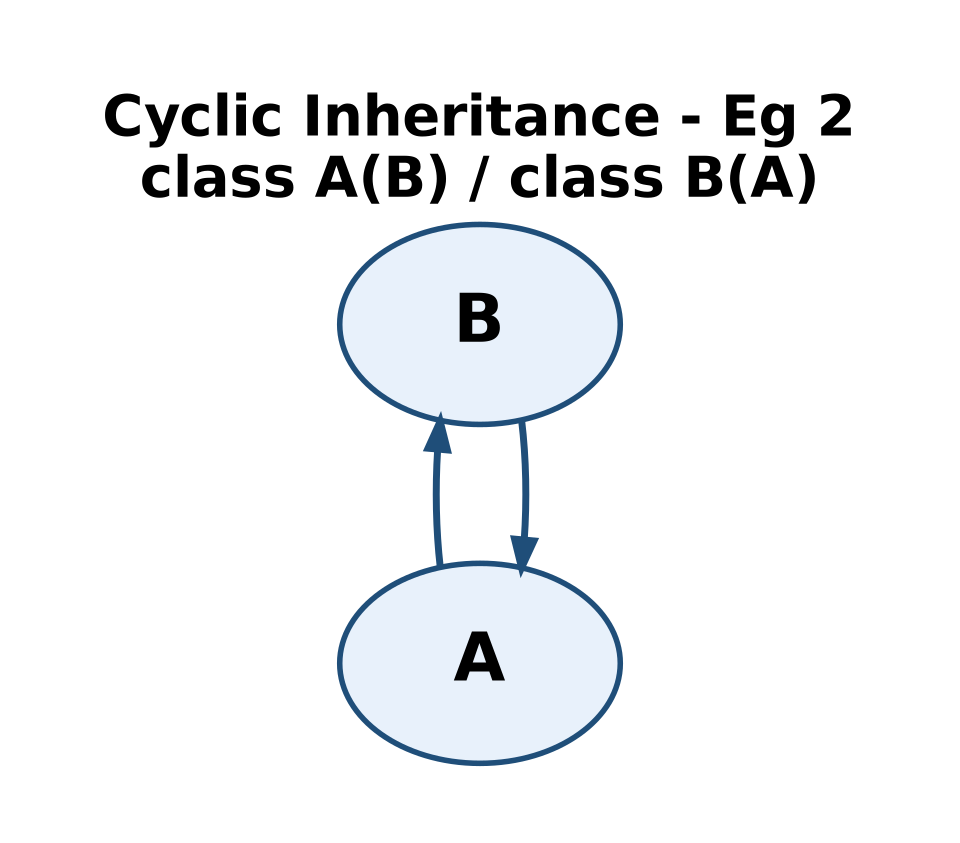
The concept of inheriting properties from one class to another class in cyclic way, is called Cyclic inheritance.Python won't support for Cyclic Inheritance of course it is really not required.
Eg - 1: class A(A):pass
NameError: name 'A' is not defined
Eg - 2:
NameError: name 'B' is not defined
Method Resolution Order (MRO)
- In Hybrid Inheritance the method resolution order is decided based on MRO algorithm.
- This algorithm is also known as C3 algorithm.
- Samuele Pedroni proposed this algorithm.
- It follows DLR (Depth First Left to Right) i.e Child will get more priority than Parent.
- Left Parent will get more priority than Right Parent.
- MRO(X) = X+Merge(MRO(P1),MRO(P2),...,ParentList)
Head Element vs Tail Terminology
- Assume C1,C2,C3,...are classes.
- In the list: C1C2C3C4C5....
- C1 is considered as Head Element and remaining is considered as Tail.
How to find Merge
- Take the head of first list
- If the head is not in the tail part of any other list, then add this head to the result and remove it from the lists in the merge.
- If the head is present in the tail part of any other list, then consider the head element of the next list and continue the same process.
Note: We can find MRO of any class by using mro() function.
print(ClassName.mro())
Demo Program-1 for Method Resolution Order
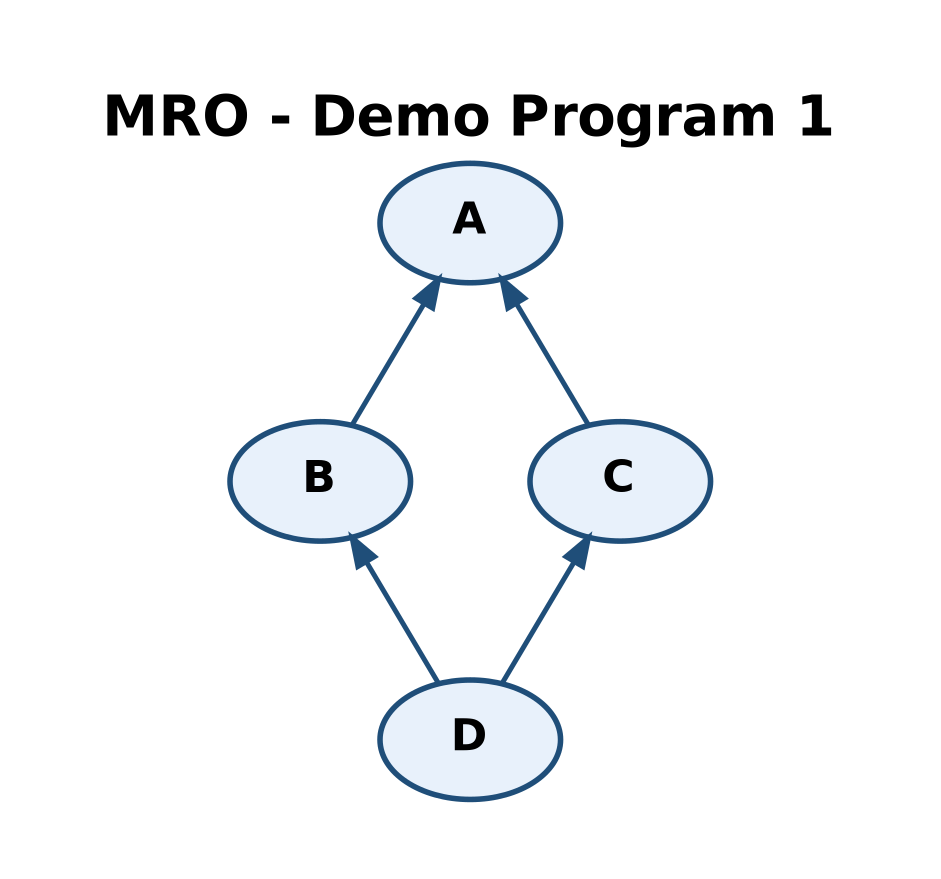
mro(A) = A, object
mro(B) = B, A, object
mro(C) = C, A, object
mro(D) = D, B, C, A, object
test.py
class A:pass
class B(A):pass
class C(A):pass
class D(B,C):pass
print(A.mro())
print(B.mro())
print(C.mro())
print(D.mro())
Output:
[<class '__main__.A'>, <class 'object'>]
[<class '__main__.B'>, <class '__main__.A'>, <class 'object'>]
[<class '__main__.C'>, <class '__main__.A'>, <class 'object'>]
[<class '__main__.D'>, <class '__main__.B'>, <class '__main__.C'>, <class '__main__.A'>,
<class 'object'>]
Demo Program-2 for Method Resolution Order
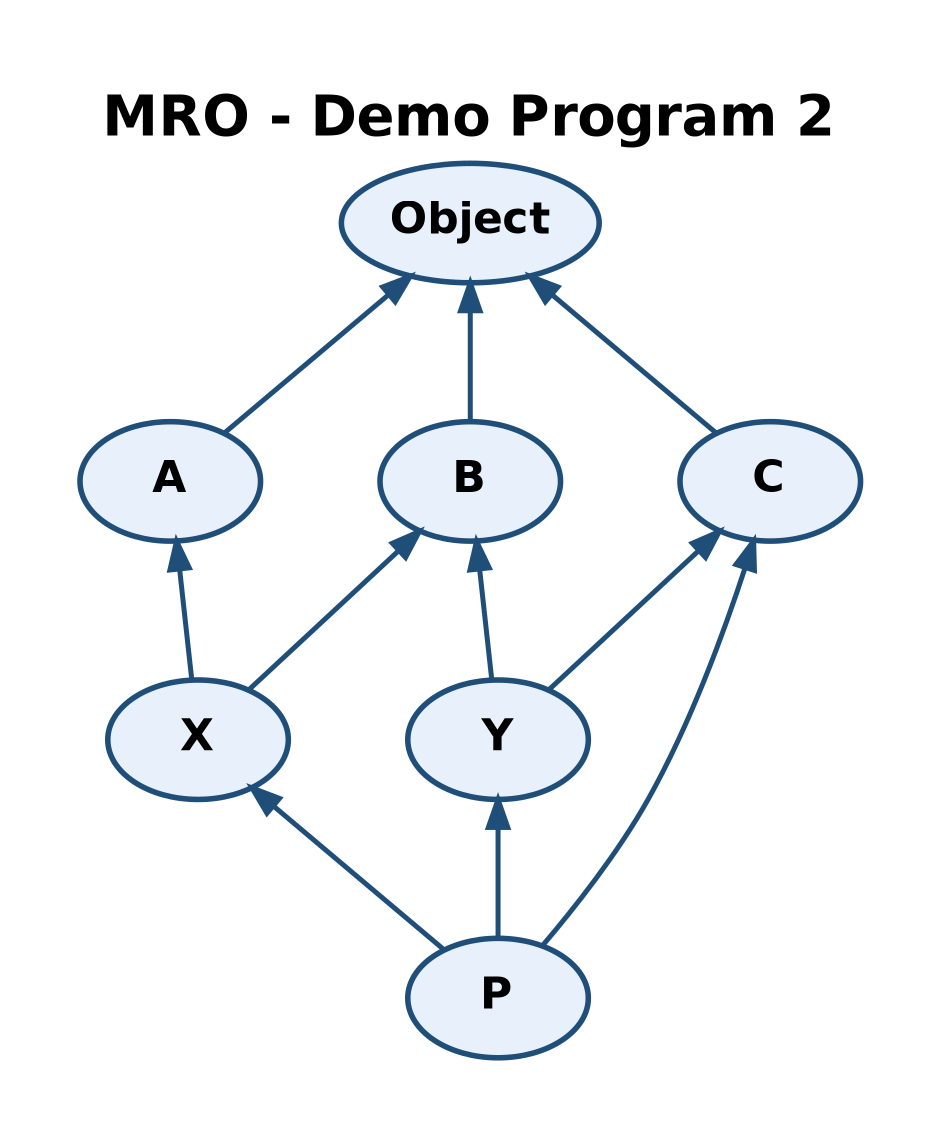
mro(A)=A,object
mro(B)=B,object
mro(C)=C,object
mro(X)=X,A,B,object
mro(Y)=Y,B,C,object
mro(P)=P,X,A,Y,B,C,object
Finding mro(P) by using C3 Algorithm
Formula: MRO(X) = X+Merge(MRO(P1),MRO(P2),...,ParentList)
mro(p) = P+Merge(mro(X),mro(Y),mro(C),XYC)
= P+Merge(XABO,YBCO,CO,XYC)
= P+X+Merge(ABO,YBCO,CO,YC)
= P+X+A+Merge(BO,YBCO,CO,YC)
= P+X+A+Y+Merge(BO,BCO,CO,C)
= P+X+A+Y+B+Merge(O,CO,CO,C)
= P+X+A+Y+B+C+Merge(O,O,O)
= P+X+A+Y+B+C+O
test.py
class A:pass
class B:pass
class C:pass
class X(A,B):pass
class Y(B,C):pass
class P(X,Y,C):pass
print(A.mro())#AO
print(X.mro())#XABO
print(Y.mro())#YBCO
print(P.mro())#PXAYBCO
Output:
[<class '__main__.A'>, <class 'object'>]
[<class '__main__.X'>, <class '__main__.A'>, <class '__main__.B'>, <class 'object'>]
[<class '__main__.Y'>, <class '__main__.B'>, <class '__main__.C'>, <class 'object'>]
[<class '__main__.P'>, <class '__main__.X'>, <class '__main__.A'>, <class '__main__.Y'>,
<class '__main__.B'>,
<class '__main__.C'>, <class 'object'>]
test.py
class A:
    def m1(self):
        print('A class Method')
class B:
    def m1(self):
        print('B class Method')
class C:
    def m1(self):
        print('C class Method')
class X(A,B):
    def m1(self):
        print('X class Method')
class Y(B,C):
    def m1(self):
        print('Y class Method')
class P(X,Y,C):
    def m1(self):
        print('P class Method')
p=P()
p.m1()
Output: P class Method
In the above example P class m1() method will be considered.If P class does not contain m1() method then as per MRO, X class method will be considered. If X class does not contain then A class method will be considered and this process will be continued.
The method resolution in the following order: PXAYBCO
Demo Program-3 for Method Resolution Order
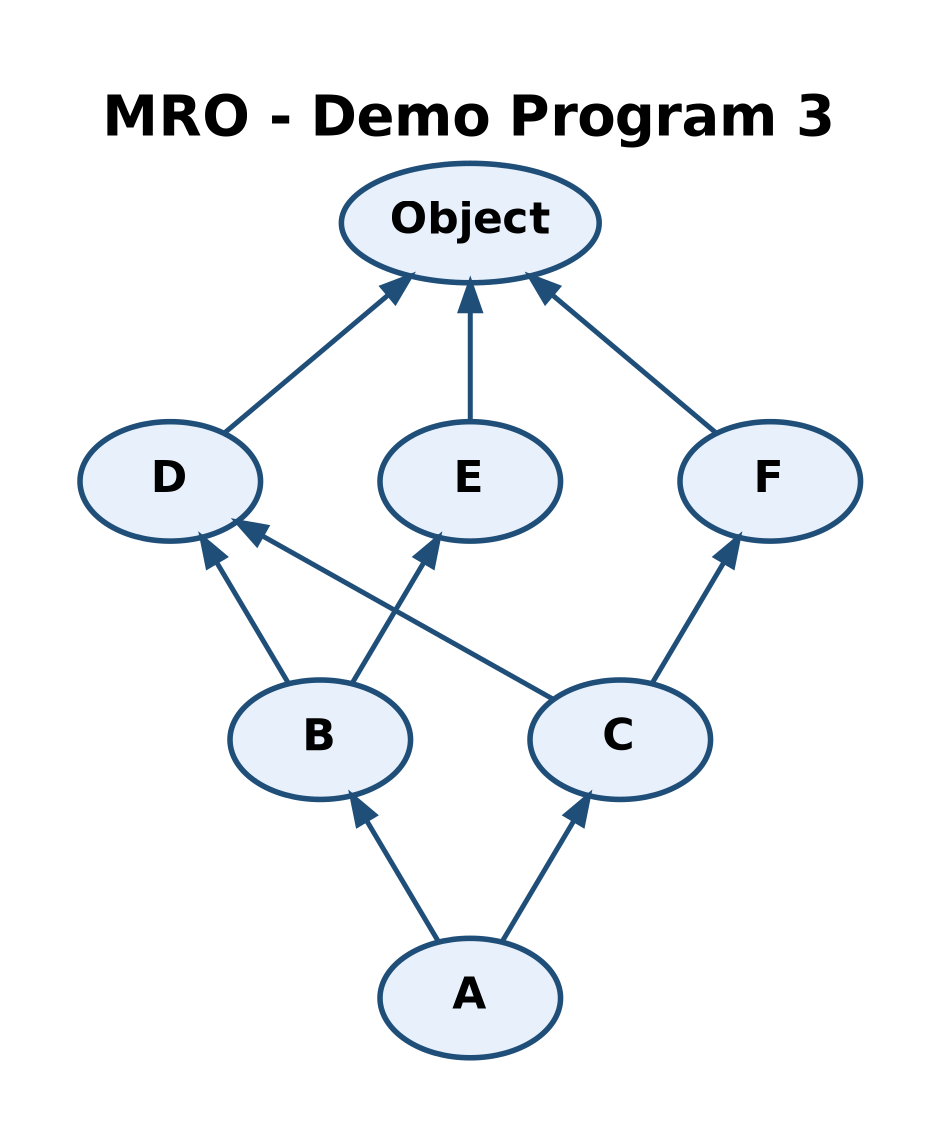
mro(o) = object
mro(D) = D,object
mro(E) = E,object
mro(F) = F,object
mro(B) = B,D,E,object
mro(C) = C,D,F,object
mro(A) = A+Merge(mro(B),mro(C),BC)
= A+Merge(BDEO,CDFO,BC)
= A+B+Merge(DEO,CDFO,C)
= A+B+C+Merge(DEO,DFO)
= A+B+C+D+Merge(EO,FO)
= A+B+C+D+E+Merge(O,FO)
= A+B+C+D+E+F+Merge(O,O)
= A+B+C+D+E+F+O
test.py
class D:pass
class E:pass
class F:pass
class B(D,E):pass
class C(D,F):pass
class A(B,C):pass
print(D.mro())
print(B.mro())
print(C.mro())
print(A.mro())
Output:
[<class '__main__.D'>, <class 'object'>]
[<class '__main__.B'>, <class '__main__.D'>, <class '__main__.E'>, <class 'object'>]
[<class '__main__.C'>, <class '__main__.D'>, <class '__main__.F'>, <class 'object'>]
[<class '__main__.A'>, <class '__main__.B'>, <class '__main__.C'>, <class '__main__.D'>,
<class '__main__.E'>,
<class '__main__.F'>, <class 'object'>]
super() Method
super() is a built-in method which is useful to call the super class constructors,variables and methods from the child class.
Demo Program-1 for super()
class Person:
    def __init__(self,name,age):
        self.name=name
        self.age=age
    def display(self):
        print('Name:',self.name)
        print('Age:',self.age)

class Student(Person):
    def __init__(self,name,age,rollno,marks):
        super().__init__(name,age)
        self.rollno=rollno
        self.marks=marks

    def display(self):
        super().display()
        print('Roll No:',self.rollno)
        print('Marks:',self.marks)

s1=Student('Durga',22,101,90)
s1.display()
Output:
In the above program we are using super() method to call parent class constructor and display() method
Demo Program-2 for super()
class P:
    a=10
    def __init__(self):
        self.b=10
    def m1(self):
        print('Parent instance method')
    @classmethod
    def m2(cls):
        print('Parent class method')
    @staticmethod
    def m3():
        print('Parent static method')

class C(P):
    a=888
    def __init__(self):
        self.b=999
        super().__init__()
        print(super().a)
        super().m1()
        super().m2()
        super().m3()

c=C()
Output:
In the above example we are using super() to call various members of Parent class.
How to Call Method of a Particular Super Class
We can use the following approaches
1) super(D, self).m1()
It will call m1() method of super class of D.
2) A.m1(self)
It will call A class m1() method
class A:
    def m1(self):
        print('A class Method')
class B(A):
    def m1(self):
        print('B class Method')
class C(B):
    def m1(self):
        print('C class Method')
class D(C):
    def m1(self):
        print('D class Method')
class E(D):
    def m1(self):
        A.m1(self)

e=E()
e.m1()
Output: A class Method
Various Important Points about super()
Case-1: From child class we are not allowed to access parent class instance variables by using super(), Compulsory we should use self only.
But we can access parent class static variables by using super().
class P:
    a=10
    def __init__(self):
        self.b=20

class C(P):
    def m1(self):
        print(super().a)#valid
        print(self.b)#valid
        print(super().b)#invalid
c=C()
c.m1()
Output:
Case-2: From child class constructor and instance method, we can access parent class instance method, static method and class method by using super()
class P:
    def __init__(self):
        print('Parent Constructor')
    def m1(self):
        print('Parent instance method')
    @classmethod
    def m2(cls):
        print('Parent class method')
    @staticmethod
    def m3():
        print('Parent static method')

class C(P):
    def __init__(self):
        super().__init__()
        super().m1()
        super().m2()
        super().m3()

    def m1(self):
        super().__init__()
        super().m1()
        super().m2()
        super().m3()

c=C()
c.m1()
Output:
Parent Constructor
Parent instance method
Parent class method
Parent static method
Parent Constructor
Parent instance method
Parent class method
Parent static method
Case-3: From child class, class method we cannot access parent class instance methods and constructors by using super() directly(but indirectly possible). But we can access parent class static and class methods.
class P:
    def __init__(self):
        print('Parent Constructor')
    def m1(self):
        print('Parent instance method')
    @classmethod
    def m2(cls):
        print('Parent class method')
    @staticmethod
    def m3():
        print('Parent static method')

class C(P):
    @classmethod
    def m1(cls):
        #super().__init__()--->invalid
        #super().m1()--->invalid
        super().m2()
        super().m3()

C.m1()
Output:
From Class Method of Child Class, how to call Parent Class Instance Methods
and Constructors:
class A:
    def __init__(self):
        print('Parent constructor')

    def m1(self):
        print('Parent instance method')

class B(A):
    @classmethod
    def m2(cls):
        super(B,cls).__init__(cls)
        super(B,cls).m1(cls)

B.m2()
Output:
Case-4: In child class static method we are not allowed to use super() generally (But in special way we can use)
class P:
    def __init__(self):
        print('Parent Constructor')
    def m1(self):
        print('Parent instance method')
    @classmethod
    def m2(cls):
        print('Parent class method')
    @staticmethod
    def m3():
        print('Parent static method')

class C(P):
    @staticmethod
    def m1():
        super().m1()-->invalid
        super().m2()--->invalid
        super().m3()--->invalid

C.m1()
RuntimeError: super(): no arguments
How to Call Parent Class Static Method from Child Class Static
Method by using super()
class A:

    @staticmethod
    def m1():
        print('Parent static method')

class B(A):
    @staticmethod
    def m2():
        super(B,B).m1()

B.m2()
Output: Parent static method